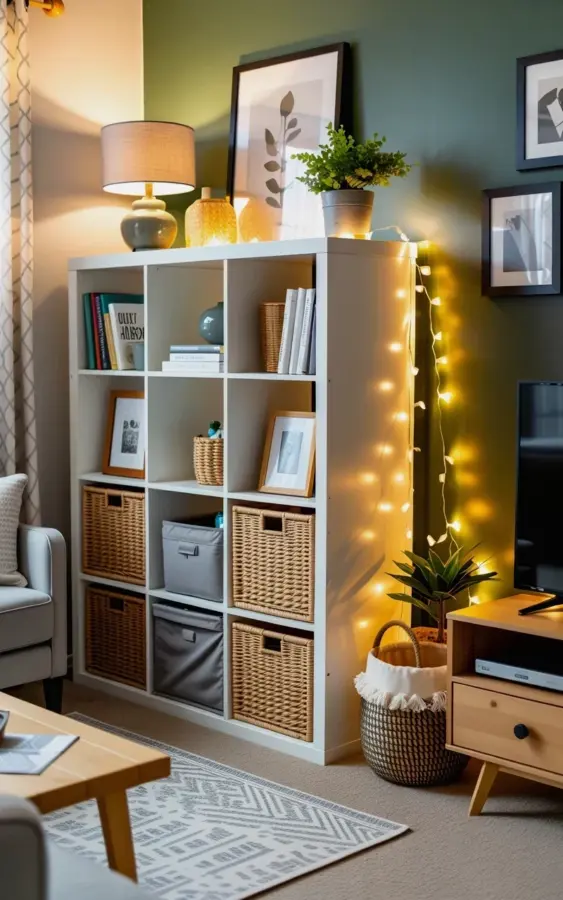
The last time I had friends over, I caught someone staring at my living room shelves with that polite smile people use when they don’t know what to say. I looked at what they were seeing, and that’s when it hit me. My beautiful white Kallax had turned into a junk museum, a museum of old mail, loose batteries, and a single flip-flop that somehow ended up on the top row. That is the #1 mistake with open living room shelving: treating every compartment like a dumping ground. You buy the shelf to display your personality, and within three weeks it just holds your chaos. The solution is actually simple, but it requires you to stop thinking about the shelf as one big unit and start thinking about it as zones.
How to Organize Bottom Shelves of a Shelving Unit
Look, the bottom two rows of any storage unit are not for pretty things. They are for the stuff you use every day, the remotes, the dog leashes, the throw blankets that keep ending up on the floor. If you leave those bottom cubes open, they will become a black hole of mismatched objects. I promise you.
The fix is to invest in the right baskets, and the specific combination that saved my living room was woven natural jute baskets alongside gray canvas storage bins. The jute adds that warm, beachy texture that makes a white Kallax feel expensive, while the gray bins ground the whole thing and hide the ugly stuff. I put the gray bins on the far left and bottom right for hidden storage. In the jute baskets, I store rolled-up blankets and extra couch pillows. Nothing about it screams “look at me,” but that’s the point. When the bottom is contained, your eye naturally drifts upward to the good stuff. It creates a visual anchor so the shelf doesn’t look like it’s about to topple over with random junk.
How to Style Top Shelves of a Bookshelf
This is where the magic happens, so do not rush it. The top compartments are your gallery space, your moment to actually show people who you are. In my setup, I devoted the top four cubbies to a curated mix of books, framed art, and a few objects that matter to me.
Here’s the thing nobody tells you: symmetry is boring, but total chaos is worse. You need a rhythm. I used a stack of three hardcover books lying flat to create height, then leaned a small framed print against the back wall at an angle. This creates depth, because if everything is flush against the back, it looks like a waiting room. For the fourth cube, I added a potted green plant in a gray container to bring in some life. Not all shelves need to be full. Let one compartment breathe and just hold a single sculptural object or nothing at all. Empty space is a design choice, not a failure.
Lighting Tricks for a Cozy Living Room Corner
You can have the perfect baskets and the perfect books, but if the lighting is wrong, the whole corner will feel flat. My initial mistake was relying on the overhead ceiling light, which is the enemy of cozy, trust me on that one. The change came when I placed a gray table lamp with a drum shade on one of the upper cubes. The warm bulb instantly made the shelf feel like a focal point instead of an afterthought.
Then I added the string lights. Honestly, I was skeptical at first, I thought it would look like a college dorm room, but the trick is to tuck them behind the items rather than draping them haphazardly over the front. The glow against the sage green wall is what really makes the whole corner feel alive. It softens all the hard edges of the Kallax and creates this golden hour effect that lasts all evening. If you want a cozy home, you need layers of light: one task light, one ambient light, and a little sparkle to finish it off.
Living Room Shelving Mistakes to Avoid
So what exactly went wrong in my initial setup? I made three critical errors that I see in almost every living room.
– I displayed things that didn’t belong in a living room, like paperwork, chargers, and that one lone flip-flop I mentioned earlier. It made the shelf feel like an office supply closet.
– I over-decorated every single cube to the point where the eye couldn’t rest anywhere. It was a visual scream, not a whisper.
– I ignored the bottom row completely, leaving it open and empty, which invited clutter to settle in like it was paying rent.
The fix is to treat the bottom row as a closed system, always with baskets or bins, and to carry the rule of three up top. Group items in odd numbers, vary the heights, and never, ever put a single item in a cube just because you feel like it needs something there.
How to Balance a 12-Cube Shelving Unit
A 12-cube unit is a big beast, and it can easily swallow a small living room if you let it. My unit is a full 12 compartments, which is a lot of real estate to manage without it feeling like a warehouse rack. The secret is the 80/20 rule: 80 percent closed storage, 20 percent open display. That’s exactly how I styled it, with the bottom eight compartments dedicated to baskets and bins, leaving only the top four for the curated stuff.
This balance isn’t just visual, it’s psychological. A unit that looks half-empty feels temporary, but a unit with solid, grounded storage on the bottom feels intentional and built-in. I also made sure to add a patterned gray and white area rug underneath the unit. It ties the whole corner together and stops the tall shelf from looking like it’s floating awkwardly in the room. Without that rug, the unit just sits there; with it, the space becomes a designated zone, a cozy reading nook even if you never actually read there.
Practical Shelf Styling Tips for the Real World
Now, for the practical side, because knowing what to do and actually doing it are two different things. The best shelf styling advice I ever got was to shop my own house before buying anything new. That lamp was originally in my bedroom, and the jute baskets came from the bathroom where they were holding towels. You don’t need to buy a whole new decor haul to fix a shelf problem; you just need to redistribute what you already own.
Also, take everything off the unit before you start styling. I know it’s painful to commit to the mess for a few hours, but rearranging items while they’re still on the shelf never works. You end up just shuffling clutter around instead of making real decisions. Pull it all out, wipe the shelves down, and only put back the things that serve a purpose or make you genuinely happy. That gray lamp with the drum shade? It made the cut because it’s useful. The dusty fake plant? It went straight into the donation pile.
So here’s the takeaway. Open shelving is not a set-it-and-forget-it kind of deal. It takes a little maintenance, and you have to be okay with the fact that sometimes life happens and a stray receipt lands in there. Just don’t let it live there. Take five minutes every Sunday to reset the bottom row and fluff the baskets. That’s it. Save this for when you’re ready to tackle your shelf styling, and seriously, go move that lamp from your bedroom to your living room. You’ll thank me later.
Leave a Comment