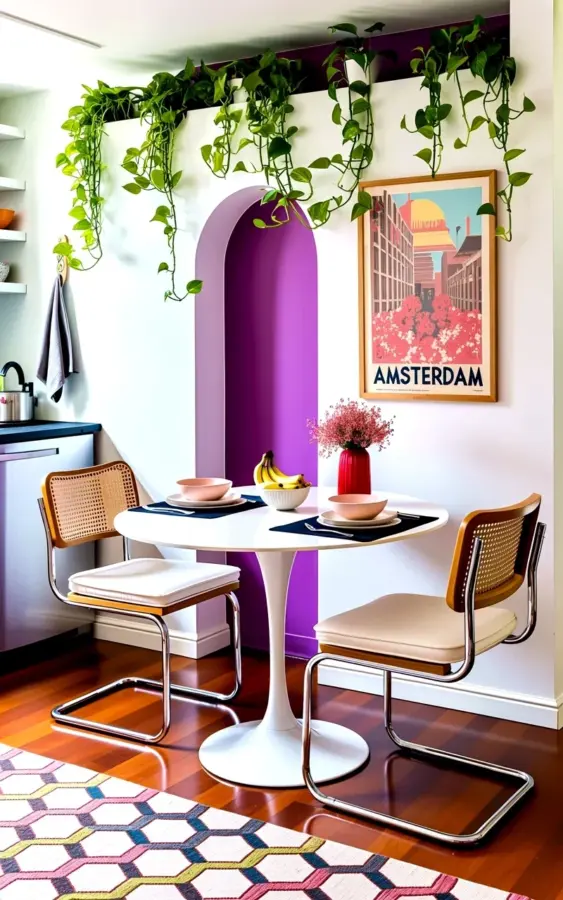
There’s a moment in every small apartment hunt when you realize the living room and the dining room are never going to be separate things. You’ll be eating breakfast where you watched TV last night, and that’s just the deal. But this small living room dining nook idea set proves that a combined space can feel intentional, lush, and actually kind of romantic. It’s not about cramming in more furniture, it’s about picking a few bold pieces that do the heavy lifting.
Look, I’ve stared at enough cramped floor plans to know that a purple archway feels like a risk. But this space pulls it off by pairing that bold color with a clean white tulip table and those chrome cantilever bar stools with woven cane backs. The whole setup is a masterclass in mixing textures. You have the glossy tabletop, the smooth metal, the organic cane, and the soft cream cushions. It’s a lot of different materials, but they all talk to each other instead of shouting.
The best part? You can copy this exact look without knocking down a single wall. It’s all about creating zones with furniture and vertical features. Let’s break down exactly how to rebuild this vibe in your own home, step by step.
Start With a Bold Paint Choice in a Tiny Footprint
That purple arch is the first thing you notice, and honestly, that’s the point. The saturated color acts like an anchor for the entire room. It carves out a “dining zone” in the open living space without needing a single partition or rug.
Here’s the thing about going bold in a small space. It doesn’t make the room feel smaller, it gives your eye a place to rest. Painting a single accent wall, or even just the inside of a niche, creates focus. I’d recommend using a deep lavender or dusty plum. Those shades are moody but they still have enough warmth to feel inviting next to your morning coffee.
– Choose a semi-gloss or satin finish, it reflects light and hides scuffs.
– Paint the inside of a bookcase, a closet nook, or a recessed wall space to fake an architectural feature.
– Pair it with a white ceiling to keep the space feeling open and airy.
Build or Fake Your Own Arched Alcove
You don’t need to hire a contractor to get that arched look. Ok so, the real arch in the photo is gorgeous, but you can create a similar illusion with paint, a mirror, or even a large piece of furniture.
If you’re renting, use removable wall decals or painters tape to paint a half-arch shape around your table. It’s a trend that has been around for a few years now, and honestly, it still looks fresh. For a more permanent fix, you can build a lightweight frame with MDF or plywood and attach it to the wall. That’s what the pros do, and it gives you a solid ledge to hang plants from.
The key (fine, I know it’s cliche but it’s true) is proportion. The arch should frame the table tightly enough to create a nook, but give you about 12 inches of breathing room on each side. Mine is a little tight and my chairs scrape the wall constantly. It’s a whole thing. Give yourself the extra space.
Use Pothos as Living Decor, Not Just a Plant
You can’t fake the energy that a cascading pothos brings to a corner. Those vines soften the hard edges of the arch and add movement at eye level. It’s literally the oldest trick in the book for making a sterile room feel lived-in.
Here’s the thing about pothos. They are stupidly hard to kill. I have one in my bathroom that gets zero natural light and it’s thriving. It produces a long vine, so you can drape it over the top of a frame, or use small clear command hooks on the wall to guide the tendrils down. The purple wall in the photo makes the green pop so vividly, it almost looks photoshopped.
Try hanging the pothos from a simple macrame planter or placing a pot on a high shelf. If you want the exact look from the photo, you need the vines *starting* at the top of the arch and falling down past the middle. It takes about six months for a standard pothos to grow that long, so buy a mature one if you want the instant effect.
Pick a Table and Stools That Don’t Fight the Space
That white Saarinen-style tulip table is a genius choice for a small living room dining nook. The single pedestal base means there are no legs to trip over, and it visually takes up way less floor space than a standard rectangular table. You can fit four chairs around it easily, but the stool setup they used here is actually way smarter.
Those chrome cantilever bar stools are a total vibe. They slide completely under the table when you’re done eating. That clears the walking path for the rest of the small living room. The woven cane backs add that vintage texture, but the chrome frame keeps it from feeling too grandma-core. If you have kids, wipeable cushions are a lifesaver. I chose velvet once and I regret it every single day.
Don’t be afraid to tuck this table right up against the wall, either. You don’t need a massive amount of clearance. I’d leave about 36 inches between the table edge and the sofa, just enough to slide past.
Style the Center of the Table With Intent
Look at how they styled the tabletop in the photo. It’s not cluttered, but it feels alive. You have the bananas in a bowl (practical), a stack of dishes (functional), and a small vase with pink flowers (pretty). That balance is everything.
Centerpieces in a small nook can’t be eighteen inches tall. You need to see over them to talk to the person across from you. A low, compact arrangement always wins. The red vase with pink flowers is a subtle pop of color that breaks up all the white and chrome. Those are real tulips or ranunculus.
– Keep the tallest element under 10 inches.
– Group items in odd numbers (one vase, one bowl, one stack of plates).
– Use fresh flowers for visual interest, they don’t have to be expensive. A few stems from the grocery store clipped short will do the trick.
– Leave one negative space on the table so it doesn’t look too staged.
Mix Vintage Poster Art With Modern Whimsy
The vintage-style Amsterdam poster with the pink floral design is the perfect finishing touch. It explains *why* the purple wall exists. The colors in the print pick up the purple paint and the pink flowers, making the whole room feel curated.
For your space, look for a vintage botanical print, a poster from a museum gift shop, or an old travel ad. Antique shops are goldmines for this, they usually have a bin of old prints for a couple of dollars. Frame them in a simple black or gold frame to make them feel intentional. Hanging art inside the painted nook ties the whole look together.
Don’t overthink it. If the poster makes you smile, buy it. That’s the entire curation process in a nutshell.
Make the Floor Work Harder
That hardwood floor does a lot for this space. It grounds the furniture and keeps the look natural and warm. If you have wall-to-wall carpet in your small living room, you can still make this look work, but you might need a washable rug to protect the fibers under the table.
The trick is that the floor is visible. There’s no rug here. That gives the eye a clear path, which makes the room feel bigger. A small living room dining nook usually benefits from less, not more, floor coverings. If you need a rug, go for a jute one that sits flush under the table, or skip it entirely. Easier to sweep, too.
Here’s a small confession. I once put a high-pile fluffy rug under my dining table just because it looked cozy in a magazine. It was a nightmare. Every single crumb got buried in the fibers. My vacuum still hates me for it. Use a low-profile mat or none at all.
Balance the Cheerful With the Practical
So, which bit would you steal? For me, it’s that cascading pothos. It brings the outdoors in and softens the architecture. For you, it might be the chrome stools or the tulip table. Either way, the lesson here is that small spaces don’t need you to compromise on style.
You just have to make every piece work double duty. The art hides the fact that there’s no window. The purple wall creates an architectural feature where there wasn’t one. The plants add texture without taking up floor space. It’s smart, thoughtful decorating, and you can absolutely pull it off in your own home. Save this one for the next time you hit a creative wall.
Leave a Comment