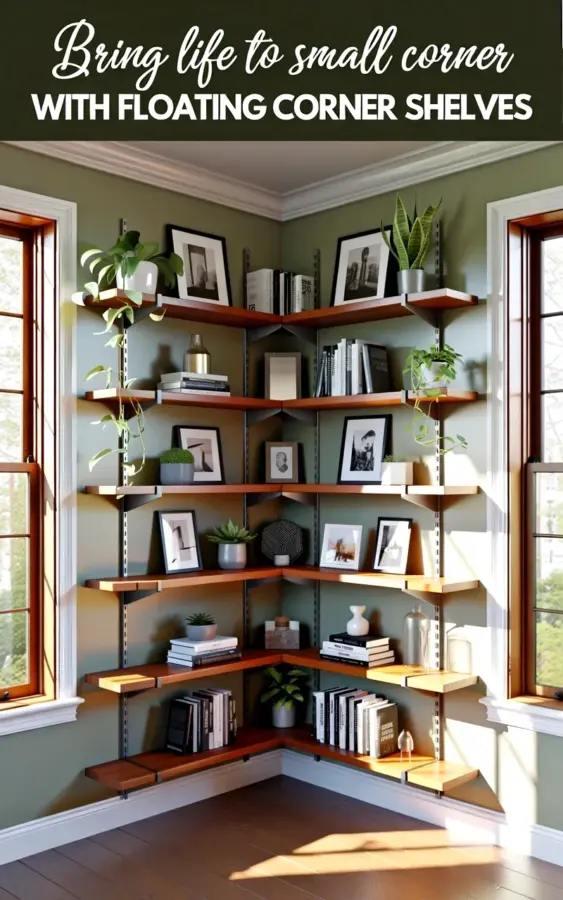
Why a Sage Green Small Living Room Calls for Corner Shelves
If you have a sage green small living room, you already know the challenge: that soft, earthy wall color begs for warmth and texture, but floor space is precious. The answer? Corner shelves. And not just any corner shelves, floating wooden shelves that follow the room’s angle, just like the L-shaped unit I spotted in a recent home tour. That setup had six shelves of different lengths, warm-toned wood with a natural finish, and a mix of books, framed photos, and trailing pothos. It looked intentional, not like afterthought storage. That’s what I want to help you recreate: a corner that feels like a curated display, not a crammed catchall.
I’m a little obsessed with sage green walls right now. They’ve been a staple for a couple years, but the 2024-2025 trend is leaning into deeper, moodier greens paired with natural wood. That’s where floating corner shelves come in. They warm up the room without blocking light or eating up floor space. And if you’re working with a tight living room, every inch counts.
Floating Corner Shelves for Plant Lovers in Tight Spaces
Let’s talk plants. The photo I’m referencing shows several small potted plants and at least two trailing pothos vines cascading down the sides of the shelves. That’s a look that says “I have a green thumb” without needing a dedicated plant stand. In a small room, floor planters can crowd the walking path. Floating corner shelves put the greenery at eye level, which also makes the room feel taller.
If you’re a plant lover with limited space, this setup is a no-brainer. The L-shape follows the corner, so you can place a pothos on the top shelf and let it trail down past the books and framed photos below. Just make sure your shelves are sturdy enough to hold a pot with moist soil. For a 10-inch pot, you want brackets that can support at least 15 pounds. I learned that the hard way with a cheap IKEA shelf that sagged after three months.
Here are a few plants that work well on corner shelves in a sage green room:
- Trailing pothos, the classic. Golden or marble queen pops against sage green.
- String of pearls, delicate, but needs bright indirect light. Place near a window.
- Snake plant (small variety), low light tolerant, upright silhouette.
- ZZ plant, almost impossible to kill. Keeps its leaves tidy.
- Philodendron micans, velvety leaves, trailing habit, looks stunning with warm wood tones.
How to Arrange Books and Photos on L-Shaped Display Shelves
The six shelves in the reference photo vary in length, some short, some longer, which creates a natural rhythm. That’s smarter than a uniform grid because it lets you group items by size. A stack of three hardcover books on a longer shelf anchors the visual weight. A small framed photo or a single ceramic vase on a shorter shelf adds breathing room.
When I style my own corner shelves, I follow a simple rule: odd numbers. Three books plus one plant looks better than two books and two plants. And don’t be afraid to lean a frame against the wall instead of hanging it, that keeps the look casual and easy to swap out. If your shelves are as warm-toned as the ones in the photo (that natural oak color), try frames in black or brass for contrast against sage green.
One practical tip: stagger the heights. A tall plant on a lower shelf, a small stack of books on the shelf above, a trailing plant on the top shelf. That way your eye moves up and down, not just side to side. The L-shape already draws attention to the corner, so you want it to feel dynamic, not flat.
Choosing the Right Wood Finish for a Sage Green Room
Warm-toned wood is the secret ingredient here. The photo shows natural-finished wood that isn’t too orange or too yellow, think light oak or walnut with a clear matte seal. Against sage green, cool gray woods (like ash or bleached oak) can feel washed out, while super dark woods (like ebony) can feel heavy because green and black together absorb a lot of light.
I’d aim for a medium brown with visible grain. That warmth complements the muted green and keeps the room from feeling sterile. If you’re buying pre-made floating shelves, look for “natural oak” or “honey walnut.” If you’re DIYing, sand a piece of pine and apply a clear polyurethane with a tiny bit of amber tint. You want the wood to glow, not compete with the wall color.
Also, consider the shelf thickness. The unit in the photo looks like 1-inch thick boards, maybe 1.5. That’s substantial enough to feel like furniture, not a piece of trim. Thin floating shelves (half-inch) can look cheap in a small room. Spend a little more on solid wood or high-quality plywood with hardwood veneer.
Storage vs. Display: Balancing Function in a Small Living Room Corner
In a small living room, every shelf has to earn its keep. The corner shelves in the photo are clearly for display, books, photos, small plants. But you can stash storage behind the scenes, too. Use a small basket on the lowest shelf for remote controls or coasters. Or stack magazines horizontally underneath a plant so the spines face out. That keeps the visual clean but still functional.
I’ve seen people overload corner shelves with random knickknacks, which makes the corner look cluttered. Instead, follow the 80/20 rule: 80 percent display (things you want to see) and 20 percent hidden storage (things you need close by but don’t want in plain view). A small woven basket or a ceramic lidded jar can hold earbuds, charging cables, or spare keys without ruining the aesthetic.
If you use the top shelf for a trailing plant, the shelf underneath can hold a stack of coasters or a small catchall tray. That way the plant still gets the spotlight, and you’re not hunting for your phone charger every evening.
Seasonal Styling for Your Sage Green Corner Shelves
Here’s the timely twist: corner shelves are perfect for seasonal swaps. In spring, add a small trailing pothos and a ceramic bunny or a pastel book cover. In fall, swap in a burnt orange cushion cover (folded, standing up) or a mini dried eucalyptus bundle. Winter could mean a tiny string of LED fairy lights woven through the plant vines. The warmth of the wood and the sage green wall provide a neutral backdrop that makes seasonal pops look intentional.
Right now (early 2025), the “quiet luxury” trend is still strong, think minimal, quality objects rather than fast decor. So for your corner shelves, invest in a few well-made items: a single ceramic vase with a dried branch, one framed art print, one stack of beautiful books. You don’t need to fill every inch. Empty space on a shelf actually makes the things you do display feel more special.
I change my own corner shelves about four times a year. It takes ten minutes and makes the whole room feel fresh. That’s the beauty of floating shelves, they’re not permanent installations. You can rearrange without patching holes, which is a lifesaver for renters or anyone who gets bored easily.
Installation Tips for Floating Corner Shelves That Look Built-In
If you’re ready to install your own L-shaped corner shelves, here’s what I’ve learned from doing it twice (including one wobbly disaster). First, use a stud finder. Floating shelves need to anchor into wall studs or use heavy-duty toggle bolts. Corners often have fewer studs because of the framing, so plan your shelf placement around where you can actually get solid support.
Second, measure twice. The shelves in the photo follow the exact room angle, usually 90 degrees, but some corners are slightly off. Cut a piece of cardboard to test the fit before you drill. If the wall angle is 92 degrees instead of 90, your L-shelf won’t sit flush. You can sand the back edge a tiny bit or use a corner template.
Third, leveling is non-negotiable. Use a laser level if you have one, or a bubble level that spans both shelves. If one side tilts even slightly, your books will slide and your trailing plant will look crooked. Trust me, I had to rehang a shelf because I was “close enough”, and it bugged me for months.
Finally, paint the shelf brackets the same color as the wall (sage green) so they disappear. The whole point of floating shelves is that they look like they’re hovering. White brackets against a green wall are distracting. A quick spray paint match solves that.
Making It Yours Without Copying the Photo
The reference photo shows a very specific look, six L-shaped shelves, warm wood, pothos, books, framed photos. But you don’t have to copy it exactly. Maybe you only have space for three shelves, or you prefer minimalist decor with just one trailing plant and a single black-and-white photo. That’s fine. The principle is the same: use the corner to add warmth and personality without taking up floor space.
If your living room has sage green walls, the floating wood shelves will act like a natural extension of the room’s calm vibe. The plants soften the edges. The books and photos tell your story. And because it’s a corner, you’ll be using a spot that often gets ignored. That’s the smartest kind of decor, when a forgotten space becomes the focal point.
So go ahead and save that Pinterest shot. Then tweak it for your own home. Swap pothos for a hoya if you want. Use navy blue book covers instead of neutrals. The wood and the green will make almost anything look intentional.
If you’re still on the fence, start with one corner shelf. See how it feels. I bet within a week you’ll be planning the next one. Corners are addictive that way.
#SmallLivingRoom #CornerShelves #FloatingShelves #SageGreen #PlantDecor
Leave a Comment