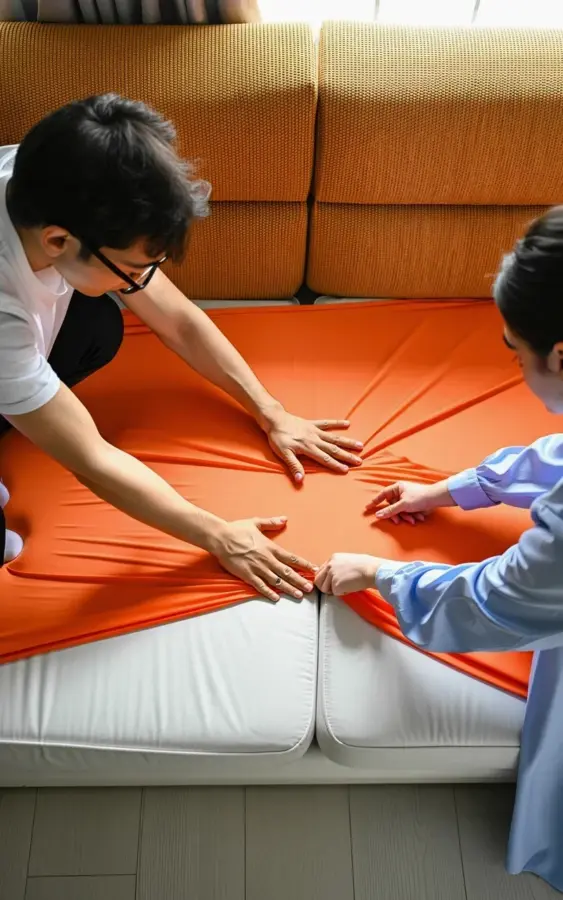
There’s a specific kind of teamwork that happens when you’re both holding a giant piece of orange stretchy fabric over a white couch. My partner and I looked like we were trying to wrangle a giant Halloween ghost, except the ghost was bright tangerine and the couch was our beloved white one. Honestly, the whole operation took about twenty minutes, but the result gave our living room an instant coziness that made it worth every second. Putting an orange sofa cover on our white couch for a cozy fall look was easier than I expected, once we figured out the right order of operations.
Why an Orange Sofa Cover Makes Sense for Fall
White couches are gorgeous in summer, no argument there. But when September rolls around and the light outside starts turning amber, a bright white couch can feel a little cold, a little sterile. The fix doesn’t have to be buying a whole new piece of furniture. A fall couch cover in a warm, saturated orange changes the entire mood of the room without touching the actual couch underneath. I’ve been doing this for three years now, and it’s genuinely my favorite seasonal switch.
The color does something psychological too. Orange is the color of pumpkins, falling leaves, and that low golden hour sunlight. It makes you want to curl up with a blanket and a mug of tea. And because the cover sits on top of the white couch, you still get those bright, clean lines peeking out around the edges, which keeps the room from feeling too heavy.
What You Actually Need Before You Start
Don’t just order a cover and hope for the best. That’s a recipe for frustration. Instead, gather a few things first and save yourself the headache. Here’s what we had on hand:
- A two-person team, because this fabric wants to be stretched, not draped. You’ll fight it alone.
- A measuring tape to confirm the cover’s dimensions actually match your couch. Our white couch is a standard three-seater, but we still measured twice.
- A pair of flat-edged kitchen spatulas. Weird, I know, but they’re perfect for tucking fabric into tight crevices without scratching the couch frame.
- A spray bottle filled with water. Lightly misting the fabric makes it more pliable and easier to pull tight.
That last one was a game changer. Nobody tells you that a dry stretchy cover just sticks to itself and refuses to cooperate. A little moisture, and suddenly it glides over the cushions like it knows where it belongs.
The Two-Person Tug of War: Getting the Cover On
Ok so here’s the exact moment we realized this was a team sport. In the photo, you can see my partner in the light blue long-sleeved shirt pulling at one corner while I, wearing a white t-shirt and my glasses, am wrestling the middle section. That high-angle view captures the pure chaos of it. We started by draping the cover over the back of the couch, letting it hang down evenly, and then we each grabbed a bottom corner.
The trick is to pull the fabric downward and outward at the same time, like you’re trying to smooth a bedsheet over a mattress that’s secretly a monster. We worked from the backrest, which already had its textured orange cover in place, and then moved to the sides. The first ten minutes were spent just getting the main body of the fabric to sit straight. Then we realized the cushions were still sitting on the couch, and that was the real challenge.
Dealing With the Cushions: The Tricky Part
Should you take the cushions off or leave them on? We tried both, and honestly, taking them off is the way to go. If you leave them on, you’re trying to tuck fabric around these big soft blocks that keep shifting under your hands. It’s like trying to wrap a present that’s made of Jell-O. So we removed all three cushions, laid them on the floor (light-colored wood, by the way, which showed every little orange fiber that shed during the process), and focused on the couch base first.
After the base cover was pulled taut and tucked into the crevices, we put the cushions back and wrapped each one individually. The bright orange fabric has enough stretch that it hugged each cushion like a second skin. But here’s a small warning: the seams on cheaper covers can pucker if you pull too hard. We used a gentle, steady pressure, and then smoothed out the wrinkles with our hands. That part took another ten minutes, but the end result was a crisp, clean orange cushion that looked almost custom-made.
That Textured Backrest Changes Everything
I was skeptical about the textured backrest at first. I thought it would clash with the smooth cushions, but I couldn’t have been more wrong. The texture adds a subtle, almost knit-like visual weight to the back of the couch, which is exactly what a cozy fall home needs. It’s not a rough or itchy fabric either. It’s soft, almost like a heavy sweater, and leaning back against it feels like being hugged from behind. My partner caught me just sitting there, pressing my back into it, and he laughed.
That texture also hides a multitude of sins. White couch covers show every little crumb or pet hair, but the orange textured backrest seems to swallow up debris. I’m not gonna lie, that alone made it worth the trouble. The only issue is that the texture catches light differently depending on the time of day. In the morning it looks like a warm terracotta, and by evening it shifts to a deeper burnt orange. Having extra pillows in neutral tones really helps tie it all together.
Styling the Whole Living Room Around the Orange
Once the sofa cover was on, the rest of the room had to catch up. I pulled in a chunky cream knit throw, swapped the cool gray pillows for ones with a subtle rust pattern, and put a small brass tray on the coffee table with a few cinnamon sticks and a single candle. It didn’t take much. The orange fabric does the heavy lifting, so you don’t need to scatter pumpkins all over the place. Actually, I did add two mini pumpkins to a floating shelf, but that was mostly for the photo. The living room decor feels intentional now, like the orange was always supposed to be there.
What surprised me was how well the orange worked with the white cushioning still visible in some spots. In the photo, you can see the white couch frame showing around the edges, and that contrast keeps the whole setup from looking like a giant orange blob. It’s a delicate balance. Too much orange would be overwhelming, but the combination of bright fabric, white base, and textured backrest hits just the right note for autumn.
How to Wash and Care for Your Fall Couch Cover
Let’s talk about maintenance, because nobody wants to spend all that effort and then ruin it with a bad wash. This cover is machine washable, which is a lifesaver. I use cold water on a gentle cycle and lay it flat to dry. The first wash is a little nerve-wracking because the orange dye tends to bleed a tiny bit, so I wash it alone with a color catcher sheet. That’s a hyper-specific tip from real experience, not from a manual. The texture on the backrest actually gets softer after a few washes, which is a nice bonus.
Between washes, I keep a lint roller nearby. The fabric does shed small orange fuzzies for the first week or so, especially along the seams. It’s not a deal breaker, just something to know. And if you spill something, deal with it immediately. The fabric is treated with a water-resistant coating, but it’s not magic. Blot, don’t rub, and it comes out clean.
Anyway, that’s the whole process. It took two people, a spray bottle, and about twenty minutes of coordinated pulling. Was it perfect? No. There’s one wrinkle on the left armrest that I keep smoothing down, and the bottom edge doesn’t sit perfectly straight. But honestly, who cares. The room feels warmer, cozier, and exactly like fall. If you’ve been thinking about a seasonal couch change, this is your sign. Grab a cover, call a friend, and just go for it. You can always switch back to the white when spring rolls around, but right now, orange is where it’s at.
Leave a Comment