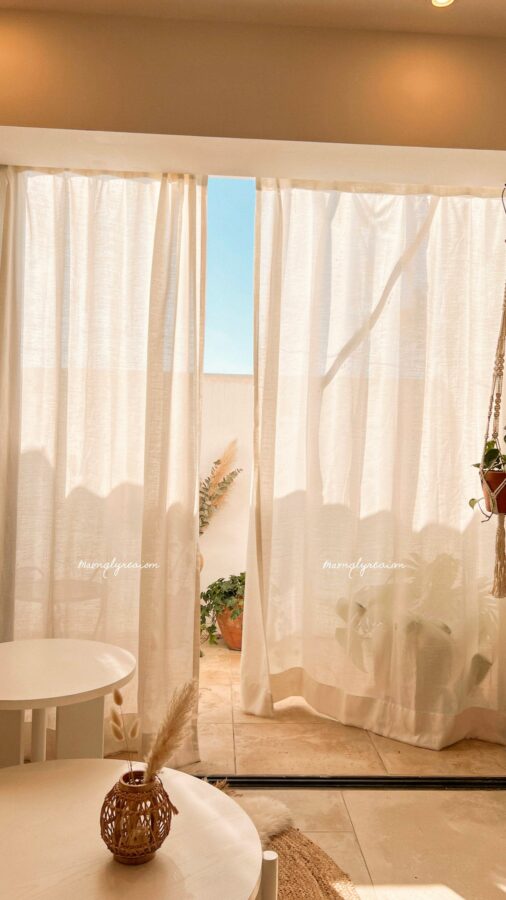
If you have sliding glass doors in your living room, you already know they bring in beautiful light and open up the view to the courtyard. But if you have ever tried to hang curtains for sliding doors without thinking it through, you probably ended up frustrated. Curtains that catch on the handle, fabric that fades after one summer, or panels that block the view you actually wanted to enjoy. These are all common mistakes, and I have made almost every single one. After experimenting with different setups in my own home, I learned that the right approach can turn a tricky window treatment into the best part of your room. Let me walk you through the most common errors people make and, more importantly, how to avoid them.
Choosing the wrong curtain length for your sliding door
This is probably the number one mistake. I see so many photos where curtains stop right at the bottom of the door frame, which makes the room feel smaller and looks unfinished. With sliding doors, the floor-to-ceiling effect is your friend. Long panels that just kiss the floor create a polished, custom look. But here is the trap: if the fabric puddles on the floor, it will collect dust and get caught when the door slides open. Aim for a length where the hem hovers about half an inch above the floor. That way you get the elegance without the cleanup. If your door is part of a wall that extends to the ceiling, mount the rod as high as possible, even just below the ceiling. It tricks the eye into thinking the room is taller.
Ignoring the track or rod system for smooth sliding
You might think any curtain rod will work, but that is a quick way to regret your purchase. Standard rods have finials that stick out, and the rings or grommets can catch on the door handle every time you open the glass door. I learned this the hard way when my curtains kept getting snagged, and I had to step around them like an obstacle course. For sliding doors, a ceiling track system is the most practical choice. It sits flush against the ceiling, the panels glide easily, and there are no dangling rings to fight with. If you prefer a rod, choose a continuous loop track or a rod with a simple return bracket that holds the curtain away from the handle. The key is to make sure nothing obstructs the door panel from sliding fully open.
Picking fabric that fades or blocks too much light
Sliding doors often face the afternoon sun, which is intense. If you choose a lightweight cotton or linen without a lining, it will bleach out within a season. I tried a beautiful pale blue linen once, and by August it looked washed out and tired. At the same time, you do not want a blackout fabric that turns your living room into a cave, especially if you have a courtyard view you enjoy. The solution is a medium-weight fabric with a light-filtering lining. Look for something like a polyester-linen blend or a velvet with a cotton backing. It will protect your furniture from UV damage while still letting soft, diffused light through. If you want the option of total darkness for movie nights, add a separate blackout panel behind your main curtain. That way you have flexibility without committing to a heavy look all day.
- Mistake: Using unlined cotton that fades within months. Fix: Choose a lined fabric or add a UV-protective backing.
- Mistake: Going full blackout and losing the courtyard view. Fix: Use a light-filtering layer plus an optional blackout liner.
- Mistake: Forgetting that the fabric will be exposed to sun on both sides. Fix: Choose a fabric labeled as fade-resistant or tested for sunlight exposure.
Forgetting about ease of sliding when choosing curtain panels
Sliding doors need to, well, slide. If you pick a single massive panel that bunches up on one side, it will block the doorway when half open, and you will end up shoving it out of the way. I prefer to use two separate panels, one for each side of the door, so you can push them to the edges. But even then, the stack of fabric on each side can be bulky. A trick that works well is to use a curved rod or a bypass track that allows the panels to stack completely off the glass. Another option is to use a double-track system where sheer panels hang on the front rod and heavier curtains on the back. This way you can slide the sheers to the sides during the day, and the heavy curtains only get pulled when you need privacy or warmth. Test the mechanism before you buy. If the curtain rings click or drag, it will annoy you every single day.
Overlooking the balance between courtyard view and privacy
If you have a nice courtyard, you probably want to see it, not hide it behind a curtain wall. But you also do not want neighbors or passersby to see straight into your living
#CurtainsForSlidingDoors #LivingRoomCurtains #SlidingDoorDecor #WindowTreatments #CourtyardView
Leave a Comment