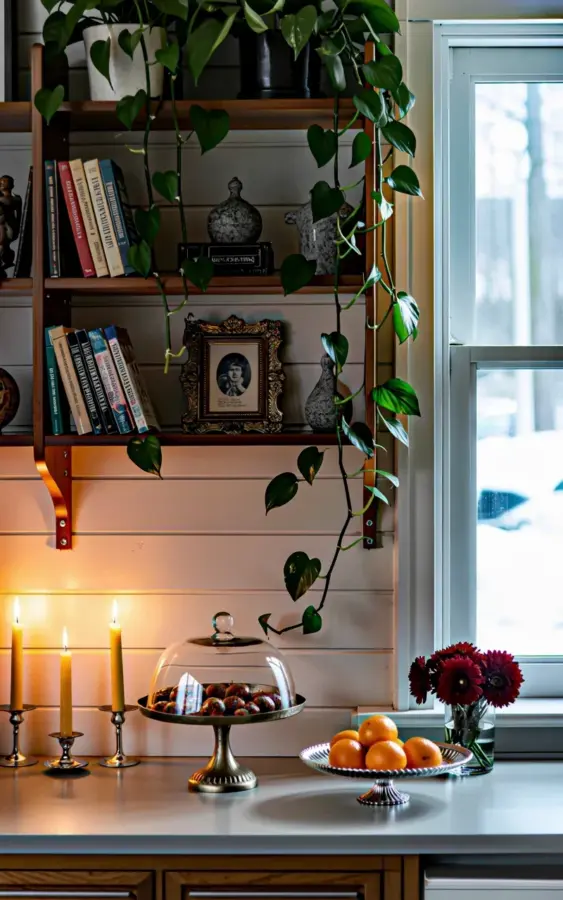
The morning light hits the red candies first. That little glass dome on the silver cake stand catches the sun and turns our wooden bookcase into the warmest corner of the cozy living room. The pothos vines have been growing wild for two years, and the vintage frames just collected around them. I didn’t plan most of this shelf. It sort of grew into itself, which is exactly why it works.
Why the Pothos Became the Main Character of This Shelf
I used to fight with this plant. The pothos would drop a leaf every time I moved it, and I almost gave up. Then I learned that pothos plant decor is less about styling and more about letting the plant do its own thing. Once I left it alone, it started climbing toward the window and then cascading over the edge like it was showing off.
The bookcase sits near a window on the right side, so the pothos gets strong but indirect daylight most of the morning. That natural light is the real secret. The vines stretch toward it, which gives the whole shelf a lazy, organic shape that no amount of arranging could copy.
I only water it when the leaves look slightly droopy. That’s not a flex, it’s just laziness. But the vines have hit the second shelf now, and the way they drape over the books makes the whole unit feel like it’s been here forever. A pothos that’s happy will do the hard work for you. You just have to stay out of its way.
Vintage Frames Don’t Need to Match, They Need to Talk to Each Other
The middle of the shelf is an ornate vintage frame with a faded botanical print my aunt gave me. It doesn’t match anything else. That’s the point. The frame is gold with weird scrollwork and a chip on the bottom left corner, and I love that chip because it makes the piece feel like it survived something.
I added a smaller black frame beside it and a tiny brass frame that’s missing its glass. They look like a family photo wall that lost track of half its relatives. Honestly, that mismatch is what makes vintage decor feel warm rather than fussy. If everything matches, it starts to look like a store display.
Try this with your own frames: lean them against the back of the shelf instead of hanging them. Leaning gives the bookshelf a casual, collected vibe, and it means you can swap out a frame in five seconds when you find a better one at a garage sale.
Glass Domes and Silver Trays Are the Easiest Vintage Decor Shortcut
The glass dome with red candies came from a flea market for eight dollars. The silver cake stand was my grandmother’s, and it wobbles if you look at it wrong. I put the candies under the dome because they’re too pretty to eat and too fragile to leave out. The natural light hits that glass every afternoon, and the candies glow like tiny stained glass windows.
The oranges sitting on the silver serving dish are there because they look like small suns. Also because I forget to buy fruit and then shove the last three oranges somewhere decorative. It works. Adding something edible to a shelf, even if it’s just fruit or wrapped candy, instantly makes a room feel lived in.
Next to the oranges is a small vase with deep red flowers. I bought the vase for three dollars at a thrift store, and the flowers are usually grocery store carnations. Carnations get a bad reputation, but they last forever and the color pops against the wood.
The Taper Candle Trick I Stole From Restaurant Tables
Two yellow taper candles sit on the shelf in simple brass holders. They’re not in a straight line. One is slightly shorter because I burned it during a power outage, and that asymmetry makes the shelf feel alive. I used to think candles needed to be on a mantel or a dining table, but putting them on a bookshelf adds height and a little flicker during evening dinners.
Yellow is an underrated candle color. White candles feel formal, and red feels seasonal, but yellow catches the light in a way that makes the whole corner look sunny even when the sky is gray. If you have taper candles that are too tall for the shelf, just cut them down. No one will know. I did it with a kitchen knife and it worked fine.
How to Do Shelf Styling So It Feels Lived In, Not Staged
There’s a method to the mess, but it’s a loose one. Start with books, then layer the pothos vines over them. That greenery breaks up the straight lines and makes the wooden shelf unit feel softer. I keep a stack of oversized art books on the bottom shelf because they’re heavy and never get read. On the second shelf, I leaned a few paperbacks instead of lining them up, because leaning books creates little pockets where small objects can sit.
Here’s a quick shelf styling checklist that actually helped me:
– Start with the big shapes: books, boxes, framed art.
– Let at least one thing trail or spill. A plant or even a stack of loose papers does this.
– Add something edible or candle-like. It tricks the eye into thinking someone actually lives there.
– Then walk away for a day. See what bothers you. Move one thing. That’s it.
Every time I break this routine, the shelf ends up looking too symmetrical. The pothos usually saves it, but not always. Symmetry is fine for guests, but a cozy home needs little imperfections.
Easy Swaps to Make Your Own Cozy Home Feel More Personal
This shelf didn’t happen overnight. It changed every few weeks for months. The biggest lesson is that a cozy home doesn’t mean magazine-ready, it means full of things that have a reason to be there. Swap out
Leave a Comment