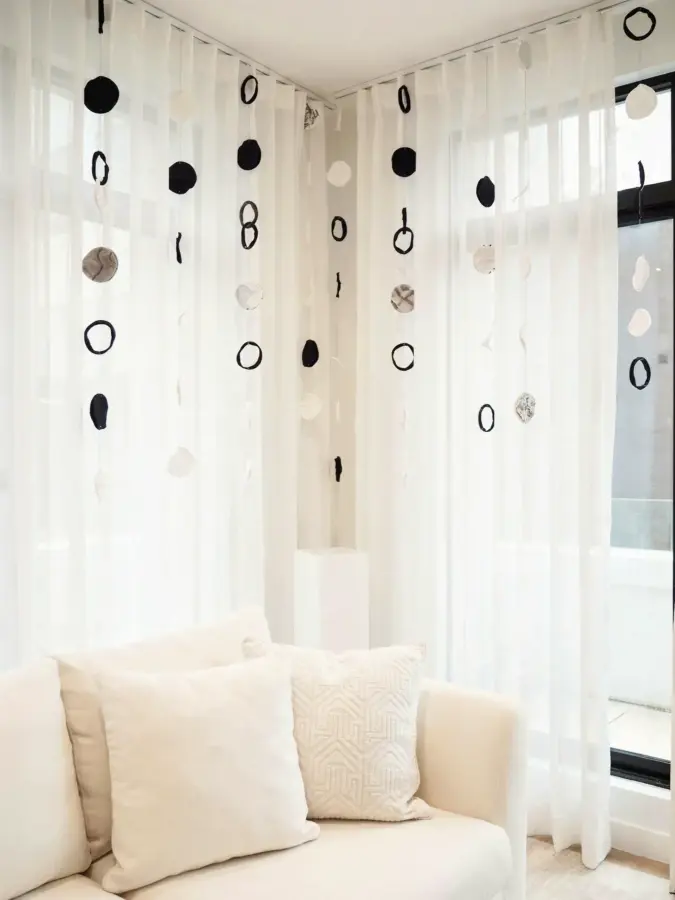
Ok so you finally caved and bought the artificial ivy LED curtain lights that keep showing up in every aesthetic decor video you scroll past. I did the same thing last year, and my first attempt was a total disaster. A friend walked into my living room, squinted at the corner, and asked if I was trying to recreate a dentist office waiting area. The difference between that failure and the cozy space I have now comes down to one fixable mistake: hanging them too tight.
Let the vines cascade. That’s basically the whole secret right there. But let me explain what that means in practice, because a Pinterest caption won’t tell you the details.
What actually goes wrong when you hang them too tight
A curtain of ivy leaves pulled flat and taunt is the fastest way to kill the effect.
When you stretch every vine out at full length, the leaves end up evenly spaced, the shape becomes a perfect rectangle, and all you see is the skeleton of the plant. Real ivy doesn’t grow like that. Real ivy spills and overlaps, drapes at weird angles, one tendril shorter than its neighbor.
The fix is straightforward: loosen up the bottom. Let the vines rest against the wall so a few longer strings reach further down than others. The LED lights will have some slack to hide behind leaves instead of being pulled into a straight line. Nobody wants a glowing grid on the wall.
And here’s the thing, once you let them hang loose, the whole corner softens. It stops looking like a product listing and starts looking like a moody green alcove.
What to look for when you buy (and what to skip)
Not gonna lie, the first set I bought was a cheap generic one from a random online listing. It worked fine for about three months, then half the LEDs started flickering like a film camera.
If you are shopping on a budget, focus on three things. One: the density of the leaves. Two: the warmth of the light. Three: the length of the vines. Everything else is just packaging.
- Buy a set where the leaves overlap enough to hide the stem completely.
- Skip anything with a blue-hued LED, cool white ruins the cozy vibe instantly.
- Measure your wall height before ordering, then add a few extra inches of length.
I will say this though: you don’t need a fancy brand. The most expensive artificial ivy curtain lights I found were over sixty dollars. The one I actually use cost around nineteen dollars from a local home supply store. The difference was not in plant quality, it was in the packaging and the hype. Read the reviews for the words “thick” or “flimsy” and look at the actual customer photos.
The cheap way to make vines cascade naturally
Ok so I tried several mounting strategies because I refused to hammer nails into my rental walls.
Command hooks worked, but only if I ignored the little plastic loop at the end of each vine. Better idea? Use clear push pins along the top edge, hidden under the leaves. You press the pin through the top leaf clusters, not through the stem, and the whole thing stays invisible.
But here is the real trick. Instead of draping the artificial ivy as a flat curtain, think of it as a layered plant wall. Clip some vines to one hook, let them fall at an angle, then grab the next cluster and hook it a foot to the side. The result looks like a lush fern corner, not a shower curtain.
I also hung a second curtain of just leafy vines, no LED lights, behind the lit strand. That gives the setup more depth. The LED string lights tuck between the leaves of the front curtain, so when they turn on, the light bounces off the green surface behind them instead of pointing straight at the room. Honestly, that one trick by itself made the biggest visual difference.
Putting the LED string lights between the leaves, not over them
The easiest way to ruin the effect is to hang the artificial ivy first, then drape the LED lights on top of the leaves.
Because then every single bulb sits at the surface, exposed, and the whole thing has a harsh glittery sparkle. You want the opposite. You want the light to glow from inside the foliage.
So grab the LED strand and weave it through the underside of the vines. Slide the bulbs between individual leaf clusters. Push a few deeper into the vine, leave a few closer to the surface. Don’t make it uniform. This takes fifteen minutes, maybe more depending on how fussy you are, and it changes everything.
One tip: check the wire path as you go. Make sure each bulb is pointing outward and not angled upward into the ceiling. I missed three bulbs in my first attempt and they just lit a blank stretch of wall.
How to build the whole corner setup for under forty dollars
So let’s assume you have a boring corner that needs some life. Here is exactly what I would buy if I were starting again on a tight budget.
Start with one artificial ivy curtain, wide enough to cover the space, with leaves dense enough to look real from a meter away. Find one in a matte green, no shiny plastic finish. Then get a separate strand of pure LED string lights, the warm white kind with small bulbs, not the big fairy bulb style. You can buy a combined set, but in my experience, the combined sets have leaves that are too thin and you end up adding extra vines anyway.
This whole setup costs:
- Artificial ivy curtain: around eighteen dollars.
- LED string lights: around nine dollars.
- Push pins or hooks: around three dollars.
- Optional extra vine curtain: around twelve dollars.
That is under fifty for a corner that now does all the talking in the room. And if you already have the curtain and lights, the pins are the only thing you need to buy.
One tiny maintenance habit that keeps it looking fresh
Yes, this is a fake plant, but no, it doesn’t dust itself.
After about a month, the leaves on my first setup looked dull, because dust settled between the leaf veins and the green turned gray. The LED bulbs also dimmed because of the dust film. I tried wiping every leaf with a dry cloth, hated it, gave up, then found a faster way.
Just take the whole curtain outside or into the bathtub and give it a gentle shake upside down. Then use a dryer sheet over the leaves to pick up the residue. The static grabs the dust without having to wipe each leaf individually. Do that once a month and your setup keeps that soft glow.
Also check that no bulbs have come loose from the socket, because a missing bulb in the middle of a chain just looks depressing. It’s a five second fix. Slide it back in, twist gently, done.
When the corner finally comes together, you’ll walk past it. Then you’ll stop. Then you’ll turn the lights on and stand there for a second, just because it feels right. If you try this in your own living room corner, share a photo with me. I genuinely want to see how the loose cascade theory translates to a different wall.
Leave a Comment